




Czech Women Abroad Who Changed History
02.02.2026 / 17:32 | Aktualizováno: 04.02.2026 / 15:51
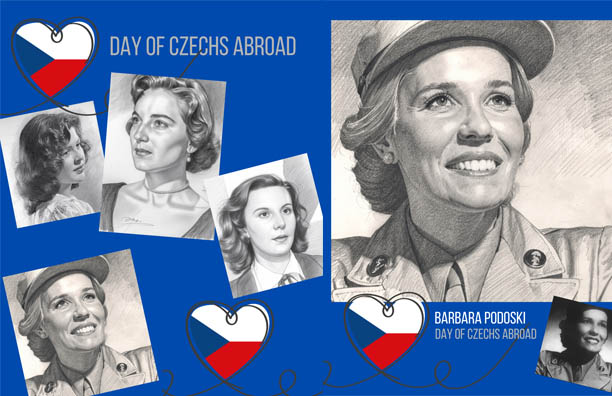
On February 4, 2026, in observance of the Day of Czechs Abroad, the Czech Embassy pays tribute to four late Czech compatriots, whose lives were thrust to the forefront of the 20th century political struggle against totalitarianism and who persevered in America, bearing the torch of the good name of the Czech nation abroad. Learn about their lives and sacrifices for freedom, democracy, and Czech-American ties, shared values, community, and culture.
Barbara Lauwers Podoski (1914-2009) was born in Brno, Moravia, leaving one day after the Germans annexed Czechoslovakia in 1939 and working for the Bata Shoe Co. abroad. After gaining US citizenship, she became a corporal in the US Women’s Army corps in counterintelligence and psychological warfare, earning the Bronze Star after one of her operations in the combat zone led to the defection of 600 soldiers fighting for the Germans on the Italian lines. After the war, she was an active member of the Czechoslovak Society of Arts and Sciences (SVU), reflecting her vibrant personality and dedication to her heritage in Washington, DC.
Vĕra Bořkovec (1926-2014), a native of Brno, Moravia, grew up in Teheran, Iran, where her father Josef Žanda was sent in 1934 as director of the Škoda company. After moving to America, she taught for more than thirty years in the Department of Language and Foreign Studies at American University, focusing on linguistics, literature and drama. She translated and published a number of stories by Arnošt Lustig as well plays of Czech playwright Josef Topol. She also published her translations of poems by Nobel Prize winner Jaroslav Seifert. She was the first woman to be elected to hold the office of Secretary General of SVU.
Helena Fabry (1925-2025) lived through the German occupation of Czechoslovakia. After the war, she worked as a journalist at Svobodné slovo, a newspaper allied with President Beneš. After the Communist coup d’etat in February 1948, she was expelled from the Journalists Union and ultimately forced to flee the country. She spent the next two years in refugee camps in the American zone of occupied West Germany. After moving to Washington, DC, she was an active member of SVU and supporting Czech and Slovak schools and community in the area.
Dagmar White (1926-2026), the daughter of General Antonín Hasal, who was President Edvard Beneš’s military adviser in the Czechoslovak resistance and the government-in-exile during WWII, survived a wartime internment camp in Moravia. Upon moving to America, she dedicated her life to music, enriching the lives of others and inspiring students and audiences alike. She was an active member of SVU and the recipient of the Silver Commemorative Medal of the Senate of the Parliament of the Czech Republic for her support of compatriot activities and spreading of the good name and traditions of the Czech Republic in the United States.