




Czech Writer Delves into Identity and the Unfinished Past
04.11.2025 / 14:15 | Aktualizováno: 08.12.2025 / 22:34
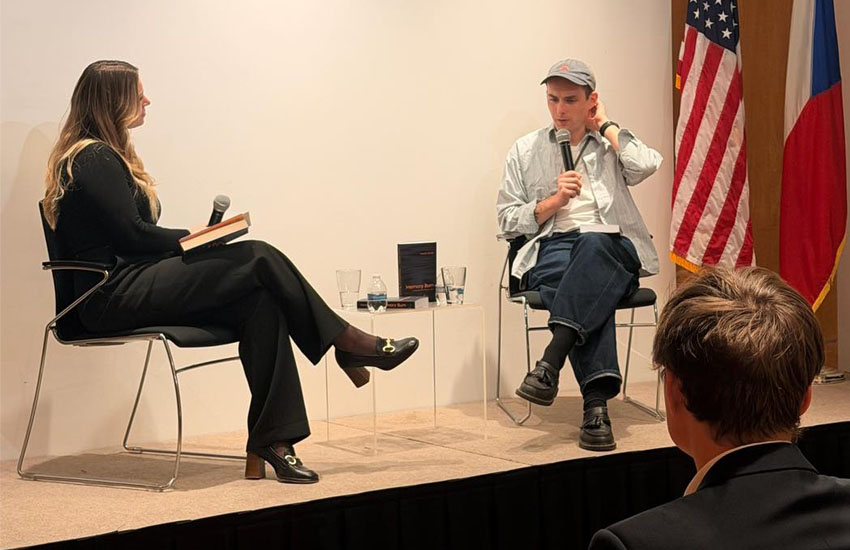
On October 29, 2025, Czech novelist Marek Torčík visited the Embassy of the Czech Republic to present his acclaimed book Memory Burn (Rozložíš paměť). The conversation, moderated by Cultural Attaché Tereza Janáková, centered on the ideas that shaped the novel rather than its plot. Torčík dove into the philosophical meaning behind his writing of the book, discussing themes such as memory, trauma, and identity.
He began with the structure of Memory Burn, which both opens and closes with death. He mentioned that this holds the narrative together. The novel moves between the years 2007 and 2021, two points that represent both the distance and the unfinished dialogue between a younger self and the adult who looks back at him. Torčík explained that the book is not a direct reconstruction of personal experience. It is a medium that allows him to examine memories that he still cannot completely articulate. He noted that he did not write from certainty. If he already understood what those years meant, there would have been no reason to write at all.
One of the more striking stylistic choices in the novel is its use of the second person. Torčík acknowledged that this choice feels unusual in Czech and even more unusual when heard in English. The intention, he explained, was to create a kind of mirror for the reader. By removing the safe distance of a traditional narrator, he invites the reader to stand closer to the emotional surface of the book.
Throughout the evening Torčík returned to the nature of memory itself. He described it as completely subjective and constantly changing. For him, memory is not an archive but the fragile material that shapes a person’s identity. He reflected on the difficulty of forgetting and how certain experiences return at the most inconvenient times. He spoke about intergenerational trauma in the Czech Republic, particularly the lingering effects of the communist period, and how these inherited wounds can surface in new forms.
Torčík also reflected on his own movement between working class origins and the academic world. He described the dislocation that can occur when a person feels out of place in both settings. He mentioned that that experience informs the emotional atmosphere of the novel, which tries to capture the uncertainty of belonging and the quiet pressure of carrying a family’s history forward.
Speaking about why he wrote the novel, Torčík mentioned the difficulty many people have in discussing uncomfortable subjects. Bullying, addiction, loneliness, the moments that mark us most deeply, rarely surface in everyday conversation. They are not raised at family dinners or in polite discussions. The silence surrounding these experiences encouraged him to write a book that could give shape to what is often left unspoken.
Toward the end of the evening, Torčík remarked that he never expected the book to be published when he first began writing it. He did not think about public reception until much later. Now, as readers from different countries approach the book, he notices that interpretations vary. In the Czech Republic, many readers ask about language and structure. Abroad, audiences tend to focus more on memory and the psychology behind the narrative. He welcomed these differences and reminded the audience that no two readers carry the same experience into a book.
The event concluded with a small reception, where guests had the opportunity to speak with Torčík individually. His visit to Washington was part of a broader U.S. tour, during which he also presented Memory Burn at the University of Chicago, Harvard University, and Columbia University.
Written by Nico Vacca