
Czech the Issues - Arnost Lustig
01.07.2010 / 15:01
(This article expired 27.03.2013 / 14:01.)
62nd Anniversary of the Israeli Independence From the Perspective of the Czech Corespondent at that Time
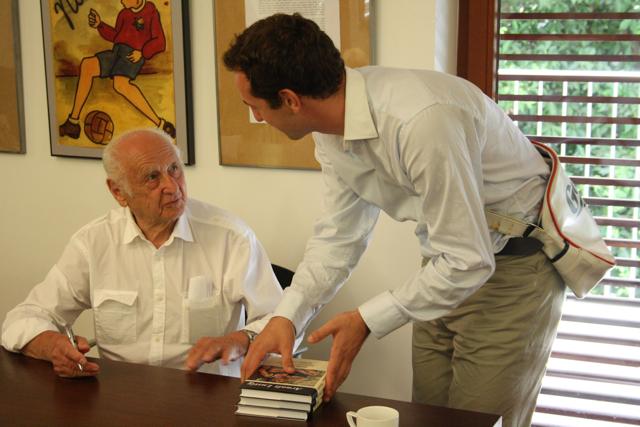
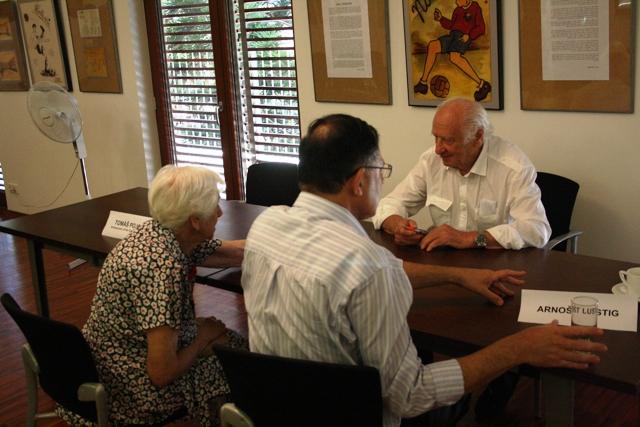
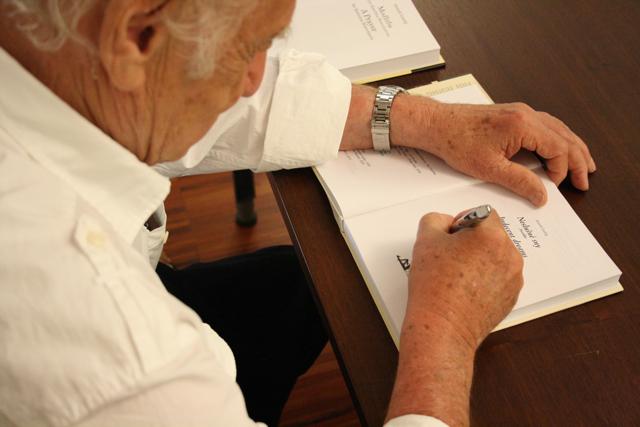
featuring Arnošt Lustig
Arnošt Lustig is a renowned Czech Jewish author of novels, short stories, plays, and screenplays whose works have often involved the Holocaust.
As a Jewish boy in Czechoslovakia during World War II, he was sent in 1942 to the Theresienstadt concentration camp, from where he was later transported to the Auschwitz concentration camp, followed by time in the Buchenwald concentration camp. In 1945, he escaped from a train carrying him to the Dachau concentration camp when the engine was mistakenly destroyed by an American fighter-bomber. He returned to Prague in time to take part in the May 1945 anti-Nazi uprising.
After the war, he studied journalism at Charles University in Prague and then worked for a number of years at Radio Prague. He worked as a journalist in Israel at the time of its War of Independence where he met his future wife, who at the time was a volunteer with the Haganah. He was one of the major critics of the Communist regime in June 1967 at the 4th Writers Conference, and gave up his membership in the Communist Party after the 1967 Middle East war, to protest his government's breaking of relations with Israel. However, following the Soviet-led invasion that ended the Prague Spring in 1968, he left the country, first to Israel, then Yugoslavia and later in 1970 to the United States. After the fall of eastern European communism in 1989, he divided his time between Prague and Washington, D.C., where he continued to teach at the American University. After his retirement from the American University in 2003, he became a full-time resident of Prague. He was given an apartment in the Prague Castle by then President Václav Havel and honored for his contributions to Czech culture on his 80th birthday in 2006. In 2008, Lustig became the eighth recipient of the Franz Kafka Prize.
His most renowned books are A Prayer For Katerina Horovitzova (1964, filmed in 1965), Dita Saxová (1962, trans. 1979, filmed in 1968), Night and Hope (1957, trans. 1985, filmed as Transport from Paradise in 1962), Diamonds of the Night (1958, filmed in 1964) and Lovely Green Eyes (2004).
CZECH THE ISSUES
Czech the issues is a series of brunch discussions on issues of European and international policy, historical and cultural heritage, EU – Israel and transatlantic relations, and international and Middle East security, organized by the Embassy of the Czech Republic in Israel. The issues are debated by a panel of Israeli and/or international experts, public intellectuals and officials, followed by a general debate of participants from among the Israeli foreign-policy and security establishments, academics, media, and the international diplomatic corps. The brunch discussions are by invitation only and are conducted in English under the Chatham House rule. Selection of discussions that have taken place in 2009:
Sept. 26 - Where Diplomacy Ends And Appeasement Begins: 70 Years From Munich with Uzi Arad and Yehuda Bauer
Oct. 31 - Territorial Integrity vs. Self-Determination, Westphalia vs. Versailles: 90 Years After The Break-up of The Austro-Hungarian And The Ottoman Empires with Shlomo Avineri and Alexander Yakobson
Jan. 9 - Europeand Islam with Bernard Lewis
Jan. 30 - The Future of the Relationship between Israel, Europe and the United States with Natan Sharansky and Oded Eran
Mar. 6 - The Outcome of the Israeli Parliamentary Elections and the Future of the Peace Process with Yossi Beilin and Dov Weissglas
Apr 10 - The Foreign Policy Outlook of the New Israeli Government with Zalman Shoval
Apr 24 - „Dichtung und Wahrheit“ in the contemporary Middle East with Amos Oz
Jun 5 - Israel and the Global Economic Crisis with Governor Stanley Fischer
Sept 18 - Perspectives of the Israeli-Syrian track with Itamar Rabinovich
April 30 - Relations of Israel and the countries of Central Europe; 20 years after the reestablishment of
diplomatic relations with Moshe Arens
galleries
Czech the Issues with Arnost Lustig