
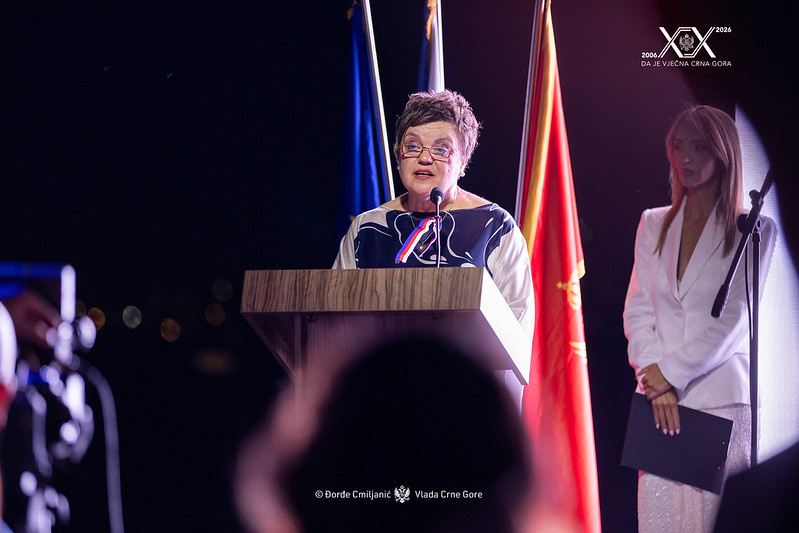



Farewell Address by Ambassador Janina Hřebíčková at the Reception Marking the End of Her Mandate, 10 September 2026
10.09.2026 / 14:27 | Aktualizováno: 11.09.2026 / 07:22
Dear Excellencies,
Dear Guest of Honor - Deputy Prime Minister Ervin Ibrahimović,
Dear Members of the Government and the Parliament,
Dear Representatives of State Institutions and Government Bodies,
Dear Representatives of Academic Institutions, Religious Communities , Media and the Non-Governmental Sector,
Dear Ambassadors and Fellow Diplomats,
Friends,
Today, I stand before you with a special task. After twenty years that I have spent in Montenegro in various professional roles, and after more than thirty years of my professional engagement connected with all the countries of the Western Balkans region, I am saying farewell to you not only as a diplomat, the Ambassador of the Czech Republic to Montenegro who has served in your country for almost five years, but above all as a person to whom Montenegro has become dear to the heart.
Unfortunately, only recently the tragic event took lives of three innocent people in Danilovgrad and I would like to express my condolences to their loved ones.
I have worked with many of you who are here today not only during the last almost five years, but for much longer. During that period, governments, presidents, prime ministers and ministers have changed, the boundaries of political alliances, social moods and the very character of the Western Balkans region and of Europe as a whole have changed. What has remained the same is the extraordinary humanity, hospitality and ability of the people of this beautiful country to overcome difficult moments and address challenging tasks.
When I first came here, I could not have known how important a part of my life this corner of Europe would become. Montenegro gradually ceased to be merely the place of my diplomatic posting. It became a place of memories, friendships, professional challenges and personal encounters that I will never forget.
I have had the opportunity to witness fundamental moments in the modern history of Montenegro: its path toward the restoration of independence, the building of democratic institutions, gradual integration into European and Euro-Atlantic structures, and its important role in regional cooperation. The Czech Republic has supported these key processes from the very beginning.
Montenegro became a member of NATO in 2017 and European integration remains its strategic objective. Today, it is approaching this goal with giant strides.
I had the honor to observe the transformation of your beautiful country and of the entire Western Balkans after having served with the United Nations, KFOR and IOM during the period of bloodshed and wartime terror in Croatia, Bosnia and Herzegovina and Kosovo and OSCE Head in Montenegro afterwards. A region once viewed primarily through the prism of conflicts from the past now has the opportunity to demonstrate its capacity for cooperation, and Montenegro can become an example for all those who will follow.
I have never believed that differences between people of any kind must be an obstacle. On the contrary. They can be a source of strength if we approach them with respect.
Diplomacy is not only about negotiations between governments. It is not only about documents, agreements and official visits. Diplomacy is above all about communication with people of different professions, with representatives of companies, academia, the media and many others.
I have met in Montenegro since 2006 to this day thousands of people who convinced me that the future of this country holds great potential. Politicians, diplomats, journalists, academics, entrepreneurs, representatives of civil society and ordinary citizens who want the same things as people everywhere else: to live in peace, in a democratic and free country, to enjoy a dignified life and to believe that the future of their children has meaning.
Today, Montenegro hosts important European and regional meetings and is playing an increasingly significant role in regional cooperation. This year is exceptional in this regard. The country chairs the Berlin Process, assumes the Chairmanship of the Committee of Ministers of the Council of Europe, and successfully hosted the EU-Western Balkans Summit in Tivat on 4-5 June 2026, where heads of state and government of the EU were able to discuss with the leadership of Montenegro and all other countries of the region, and where Czech Prime Minister A. Babiš visited Montenegro for the first time. Subsequently, he welcomed Prime Minister M. Spajić of Montenegro in Prague on 24 July 2026. President Pavel received Prime Minister Spajić at Prague Castle on the same day.
The main topics discussed included Montenegro's European integration into the EU, trade and defense-industrial cooperation, and cooperation in combating cyber and hybrid threats.
The latest major success in supporting the policy of European and Euro-Atlantic integration was the signing of the Agreement between the Governments of the Czech Republic and Montenegro on Cooperation in the Field of Defense, which entered into force on 3 June 2026.
Cybersecurity represents another area of long-term cooperation between our countries, reflecting the good reputation of Czech know-how in Montenegro and our continuous support for Montenegro's resilience as an ally within NATO and, I believe, soon within the European Union as well. Visits by Czech representatives to the Government Cyber Security Centre at the Ministry of Public Administration, including the joint visit by President Petr Pavel and the Director of the National Cyber and Information Security Agency (NÚKIB), Lukáš Kintr, in January 2025, as well as last year's visit by the Minister of Education, Science and Innovation of Montenegro, Anđela Jakšić-Stojanović, to the headquarters of NÚKIB in Brno, prepared the ground for the pilot project implemented this year under the CyberVac programme.
The Czech Republic governments have consistently supported Montenegro's accession to the European Union. This support has been confirmed many times not only during the Czech Presidency of the Council of the EU in 2022 via different manner - series of expert online seminars on European integration, during which Czech experts provided consultations to employees of Montenegrin ministries, through the above-mentioned visit of the Czech Prime Minister and the preceding visits of six Czech government ministers accompanied by delegations of security and economic experts, through two business forums where dozens of Czech companies were able to meet their Montenegrin partners.
The President of the Czech Republic visited the President and other state officials in Montenegro in January 2025 and will reciprocally welcome the President of Montenegro in Prague on 3 November this year.
Our two countries have managed to cooperate on projects apart of Montenegro's EU integration and economic and security cooperation also on the fight against hybrid threats, cybersecurity, science, education, culture, media, civil society, parliamentary cooperation across political parties, including support for the activities of the Women's Club, human rights including women's rights and combating domestic violence, healthcare, environmental protection and many other areas.
Montenegro was visited in 2022 and again in 2024 by the Czech Minister for European Affairs, Martin Dvořák.
Minister Dvořák welcomed Minister Maida Gorčević in Prague in 2024.
The Czech Republic was visited in 2022 by President Milo Đukanović and Deputy Prime Minister Ervin Ibrahimović. In March 2024, Foreign Minister Filip Ivanović visited the Czech Republic, while Czech Foreign Minister Jan Lipavský visited Montenegro in March 2025.
In May 2024, the Czech delegation led by Minister of Transport Martin Kupka included more than twenty Czech companies during its visit to Montenegro have visited Minister of Transport and Maritime Affairs Filip Radulović.
Two Montenegrin-Czech business forums were held between our countries, along with the fifth session of the Joint Commission for Economic Cooperation, negotiations concerning railways and motorway infrastructure, presentations of Czech transport technologies, and expert seminars on road safety and smart mobility.
Minister of Education, Science and New Technologies of Montenegro Anđela Jakšić Stojanović visited Czech Republic on the invitation of Marek Ženíšek, Minister of science, research and innovation, in June 2025. This culminated, among other achievements, in Montenegro obtaining observer status in the European research consortium ELI ERIC, whose statutory seat, together with the largest laser center in Europe, is located in Dolní Břežany near Prague. On 19 June 2025 in Prague, Anđela Jakšić-Stojanović signed a joint declaration on strengthening scientific, research and innovation cooperation. The delegation also included the director general of Ministry of Culture and Media, dr Jelena Jovanović – Nikolić as the representatives of Old Royal Capital of Cetinje.
In the area of taxation and investment cooperation, together with the Minister of Finance of Montenegro we signed the Agreement on the Avoidance of Double Taxation in Podgorica on 20 February 2024, which entered into effect on 30 January 2025.
We maintained active cooperation in higher education. For the fourth consecutive year, courses in the Czech language and culture have been offered at the Faculty of Political Science and the Faculty of Philology of the University of Montenegro in Podgorica and the Faculty for Montenegrin Language and Literature in Cetinje in cooperation with the University of South Bohemia in České Budějovice.
Numerous other cultural projects were carried out like exhibitions, musical and literature encounters, projects supporting role of civil society and freedom of media and those promoting the ideas and political, human rights and artistic legacy of Václav Havel. Our cooperation with the Karver Book Festival which has long supported the European and Balkan literary and film scene continues.
There were also expert projects focused on gender mainstreaming and the Sustainable Development Goals, environmental protection, combating domestic violence, and assistance in implementing relevant legislation and strategic documents.
In August 2025, the Czech Republic provided humanitarian assistance when Czech firefighters helped combat forest fires in Montenegro through the European Union Civil Protection Mechanism.
I would like to thank the Government of Montenegro and all state and government representatives for our excellent cooperation to date. I greatly appreciate your active approach to building a modern European country despite all challenges.
Our joint efforts to promote innovative solutions, strengthen democratic values, pursue integration into European structures and maintain dialogue among state administration, academia and civil society demonstrate that effective partnerships bring tangible results for the future of all of us.
I thank the media, non-governmental organizations and academic community of Montenegro for their tireless efforts to work professionally and to spread the European message through the cultivation of public discussion on European values and our common future. In today's world, independent and high-quality journalism that is not afraid to clearly identify key issues is essential.
The non-governmental sector is a driving force of critical thinking, and universities shape our future generations.
I thank those with whom it was not always easy to agree. I often learned the most from those discussions.
I thank everyone who helped me get to know Montenegro through its cities and mountains, its coast and interior, its history, culture and traditions, and above all through the people who love their country and want the best for it.
I thank all my colleagues at the Embassy of the Czech Republic for their outstanding cooperation.
I would also like to thank the Director of the CzechBusiness Office in Podgorica, Mr Izudin Gušmirović, for many years of excellent cooperation helping the Czech Republic implement important economic diplomacy initiatives. I have known Izudin for many years; he has become a friend and I value him greatly.
Last but not least, I would like to thank the Czech companies COLT CZ, represented here tonight by Mr Jan Holeček, a member of the Board of Directors, together with his colleague Mr Stanislav Bobek, Director at Česká zbrojovka, and INSET, represented by its CEO, Mr Václav Rydl. Without their support, tonight’s farewell reception would not have been possible. I would also like to thank all the other Czech companies for their continued support in organizing receptions to mark the Czech National Day throughout my tenure in Montenegro.
I believe that Montenegro will succeed on its European path. I believe in the people who are building that future every day.
I wish you all a pleasant evening.