


Czech Participation in the Unique JUNO Neutrino Experiment
21.11.2025 / 03:20 | Aktualizováno: 01.12.2025 / 03:23
On 19 November, a ceremonial launch was held for JUNO, a neutrino research project that is in many respects the largest of its kind in the world, and which also carries a Czech footprint thanks to the involvement of our scientists.
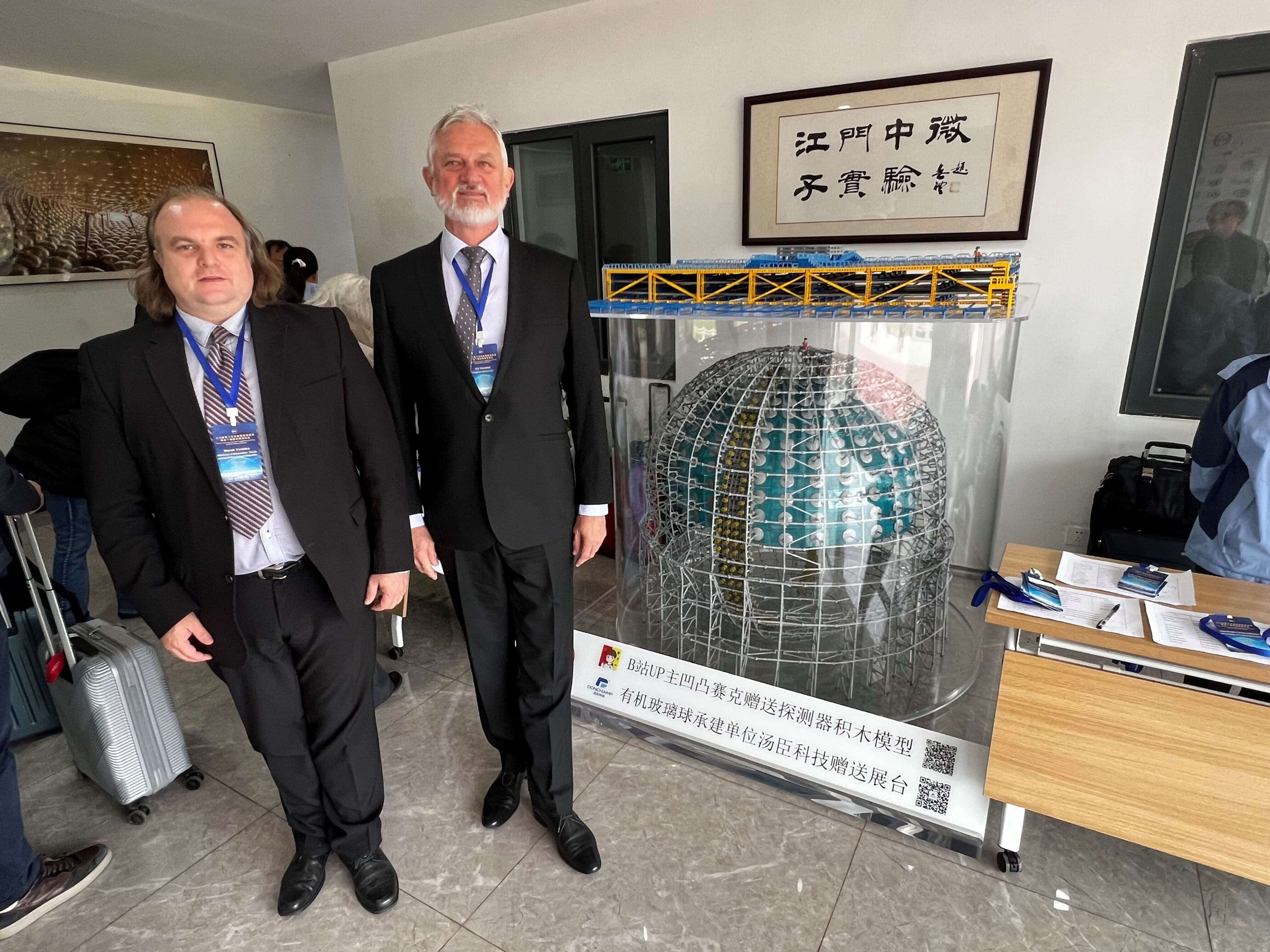
The JUNO Neutrino Observatory (Jiangmen Underground Neutrino Observatory) in Guangdong Province in southern China was put into operation at the end of August this year, and has since begun collecting its first data. It is a massive spherical detection station filled with approximately 20,000 tonnes of liquid scintillator, surrounded by tens of thousands of photomultiplier tubes, all located about 700 metres below the Earth’s surface. The instrument is designed to detect neutrinos, extremely light particles that interact only very weakly with matter, and makes it possible to measure their behaviour with unprecedented precision. Among the goals of the experiment is to determine the hierarchy of neutrino masses and refine the parameters that describe their oscillations.
Technologically, JUNO is a highly ambitious project. Its construction involved the development of an extremely pure scintillator, improved photomultipliers, and precise calibration systems. Thanks to these innovations, the detector achieved excellent results in initial tests.
The project is an international collaboration of roughly 700 scientists from 17 countries, including the Czech Republic. The team from Charles University was represented at the ceremonial launch by its leader, Mr. Vít Vorobel. Also present at the event were Mr. Marek Vyšinka, head of the Department for Research Infrastructures at the Ministry of Education, Youth and Sports, Ambassador Martin Tomčo, and economic diplomat Adam Kupka.
The Czech Republic’s involvement in the JUNO collaboration is proof of our expertise and contribution to international research. Among the main tasks of the scientists from Charles University were investigating the nonlinearity of the liquid scintillator and developing a calibration system for the muon veto detector using 135 installed flash units. Thanks to this involvement, the project has become a successful milestone in scientific cooperation between the Czech Republic and China.