




Statement of Anna Kárníková from the Czech Republic on local level of sustainable development
10.02.2015 / 08:15 | Aktualizováno: 03.03.2015 / 08:33
On 9-10 February 2015, the President of the General Assembly convened a High-Level Debate on Means of Implementation for the post-2015 development agenda.
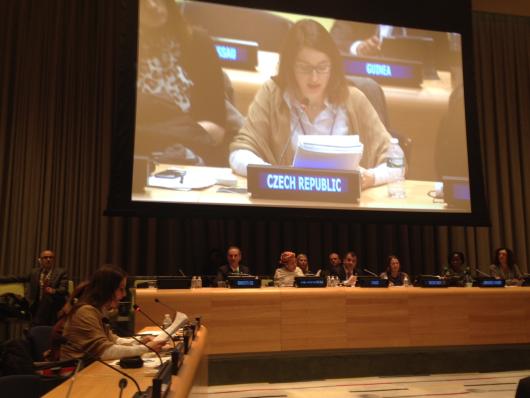
In a panel discussion on the role of municipalities, cities, and parliaments in development and its financing, Anna Kárníková, sustainable development director at the Office of the Government of the Czech Republic, reiterated in a national statement the importance and innovative spirit of local level of sustainable development.
Text of the statement:
Mr. Chair, Excellencies, distinguished colleagues,
First of all, I align myself with the EU´s statement from the yesterday´s first plenary session. Secondly, based on our experience in the Czech Republic, I would like to highlight the linkages between sustainable development initiatives at the local level and the global architecture.
As the Secretary General argued in his Synthesis Report, public institutions at all levels need to be inclusive, participatory, and accountable to the people. Local authorities represent the type of government closest to citizens. They represent the level at which civic participation in public decision-making can thrive.
As we remind ourselves, from January next year the post-2015 framework will be all about implementation. If empowered to fulfill their roles, local authorities and communities can effectively lead implementation in some segments. They also tend to come up with innovative approaches to achieving sustainability.
In 1992, the adoption of the Local Agenda 21 inspired a rather impressive municipal European movement. Two years later, nearly 3000 local authorities from over 40 European countries signed the so-called Aalborg Charter. They committed to work together to make sustainability an inherent part of their development.
In response to this process, Czech municipalities have organized themselves under the Healthy Cities Network, which currently represents 70 % of Czech population (which is around 10 million people). In the last 10 years, they have achieved remarkable results in setting up a complex management and monitoring system to achieve sustainable development. Czech cities have introduced strategic planning and management tools to attract social innovation, and encourage participation. Their key to success is to support only such activities that contribute to the quality of life and at the same time respect the principles of sustainable development.
In the Czech Republic, we see cities which have developed their own vision of their future in a wide public consultation process. We see cities becoming energy independent. We see cities solving social problems in a way that leaves no one behind. At the local level we find the most convincing examples of lived sustainability.
Mr. Chair, Excellencies,
At Monterrey we agreed that each country is primarily responsible for its own development. Efforts launched at a local council meeting have the potential to boost a country’s ownership. The road towards sustainability at the national level might sometimes seem abstract and distant. It is then the local level that motivates us to strive further.
Local Agenda 21 was a crucial step towards sustainable development at the local level. Based on the European experience in general, and the Czech case in particular, I am convinced that it can become an inspirational contribution to the post-2015 implementation efforts.
We also look forward to sharing with you our experience during the preparatory regional conference of Habitat III, which the Czech Republic offers to host in 2016.
I thank you.