
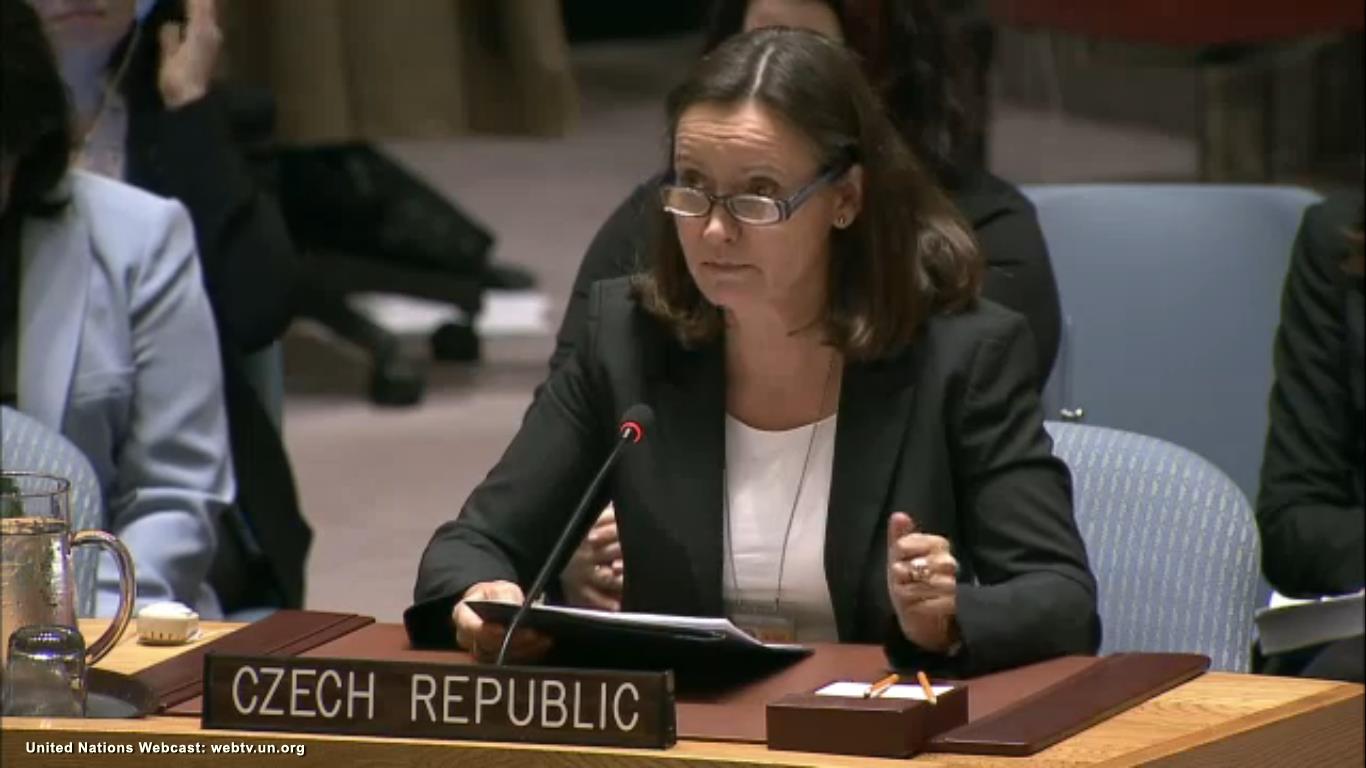




Czech Republic co-sponsored UNSC Resolution on women, peace and security
15.10.2015 / 01:15 | Aktualizováno: 21.10.2015 / 03:40
On 14 October 2015 the Czech Permanent Representative to the UN Ms Edita Hrdá made a statement at the high-level open debate of the UN Security Council which took place on October 13-14 on the occasion of the fifteenth anniversary of adoption of the first UN Security Council resolution on women, peace and security1325.
The Czech Republic also co-sponsored the resolution 2242 (2015) on women, peace and security agenda that was adopted on this occasion.
Statement of the Czech Republic:
„Women, Peace and Security“
High Level Review of the Implementation of Resolution 1325 (2000)
October 14, 2015
Excellencies, Distinguished Participants, ladies and gentlemen,
Resolution 1325 on women, peace and security was a visionary document, one that perfectly recognized the role of women in the prevention and resolution of conflicts, peace negotiations, peace-building, peacekeeping, humanitarian response and in post-conflict reconstruction. Fifteen years after its adoption, we have A Global Study on the Implementation in front of us, showing remarkable progress based on concrete indicators, identifying gaps to be filled in as well as emerging trends and priorities for action.
The Czech Republic takes the agenda of 1325 very seriously and we have tried hard to implement it, both nationally and internationally.
At the national level, the Government of the Czech Republic approved lately its first long-term framework document for gender equality. Concurrently, the Czech Ministry of Defense adopted in June 2015 “Defense Ministry Action Plan to Implement UN Security Council Resolution 1325” which is to declare the effort of the MoD to meet obligations set out in this resolution and to inform experts from among the public and organizations concerned about the measures adopted to implement the resolution principles.
Internationally, the Czech Republic became the “lead nation” of a program, requested by Jordan as part of partner cooperation and implementation of Resolution 1325, focused on the training of Jordan female soldiers in EOD (Explosive Ordnance Disposal).
The Czech Republic in more general terms seeks to strengthen the position of women in society through development cooperation as well as humanitarian aid. This goal is enshrined, among others, in the Strategy of Multilateral Foreign Development Cooperation for the period 2013 – 2017. In fulfilling these priorities, the Czech Republic cooperates with relevant UN agencies, particularly with the UNFPA, UN WOMEN, UNHCR and the UN Programme on HIV / AIDS (UNAIDS). In the field of humanitarian aid the Czech Republic pays special attention to victims of gender-based violence. Gender perspective continues to be taken into account also as a cross-cutting target within projects in countries like Iraq, South Sudan, the CAR, Syria and Ukraine.
Apart from these “traditional means” of foreign policy, the Czech Republic has available the so called Transition Promotion Program. It is a financial instrument aimed at supporting democracy and human rights, using the Czech Republic’s recent experience with social transition and democratization of the country. Gender mainstreaming belongs to the cross-cutting principles reflected in the Program. In the last years, the Czech Republic implemented in cooperation with non-governmental organisations a number of projects in more than 7 countries worldwide, including Burma/Myanmar, Zimbabwe, Palestine and Egypt, focused on protecting women’s rights and enhancing their participation in public life.
Esteemed Guests,
The Study comprehensively proves that the participation of women at all levels is the key to the operational effectiveness, success and sustainability of peace processes, peacebuilding and peacekeeping efforts. This is one of the reasons why the Czech Republic authored and negotiated, already three times, in Geneva a resolution on equal political participation. It urges all states to eliminate barriers that limit full and effective participation of all segments of society, including women, in political affairs. It was always adopted by consensus and co-sponsored by a large number of countries.
Ladies and gentleman,
I wish resolutions such as 1325 or on equal political participation, that have been so widely recognized and supported, were soon to become obsolete as all their principles were fully and globally implemented and respected.
----------------